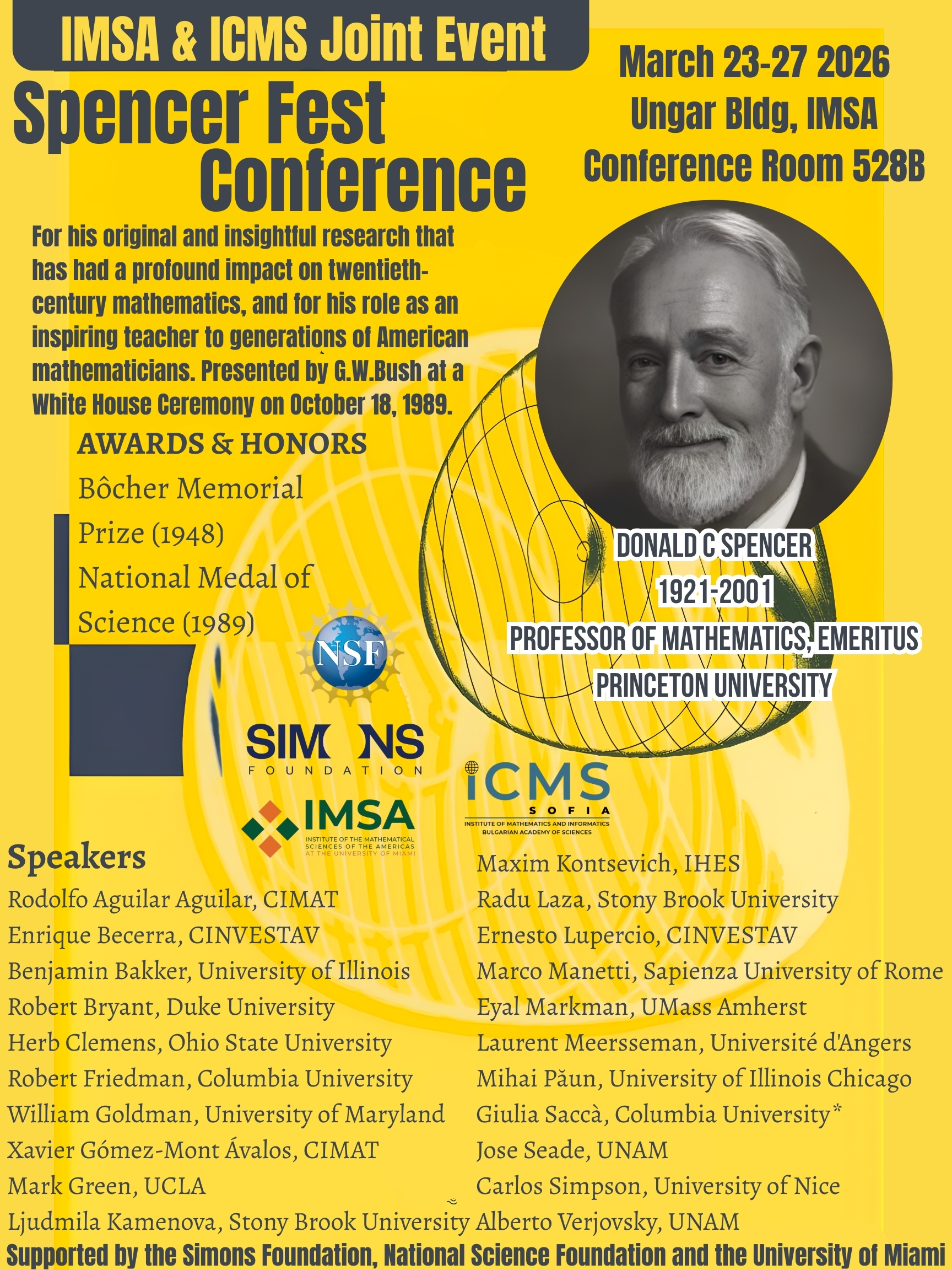
Dates: March 23-27, 2026
Location: Ungar Bldg, Room 528B, 1365 Memorial Dr, Coral Gables, FL 33146
Live Video Available via Zoom
To register, please click here.
This is an IMSA event, supported by ICMS, IMSA, the Simons Foundation, National Science Foundation and the University of Miami.
For his original and insightful research that has had a profound impact on twentieth-century mathematics, and for his role as an inspiring teacher to generations of American mathematicians. Presented by President Bush at a White House Ceremony on October 18, 1989.
Schedule
Monday, March 23, 2026
| 10:00am |
Jose Seade, UNAM: Discrete Group Actions on CP^2
Kleinian groups were introduced by Poincaré in the late nineteenth century as discrete groups of automorphisms of the complex projective line $ \mathbb{CP}^1 $. In the late 1990s, Seade and Verjovsky initiated the dynamical study of what they termed \emph{complex Kleinian groups}, namely discrete groups of automorphisms of $ \mathbb{CP}^n$ for $ n \ge 1 $.
In this talk, I will present developments from the past two decades, primarily due to Ángel Cano, Waldemar Barrera, Juan Pablo Navarrete and myself, focusing on the case $ n = 2 $. In this setting, we can now propose a Sullivan-type dictionary relating endomorphisms of $ \mathbb{CP}^2 $ to discrete subgroups of $ PSL(3,\mathbb{C}) $.
|
| 11:15am |
Maxim Kontsevich, IHES (Zoom): Kodaira Spencer theory for non commutative spaces
|
| 2:00pm |
Ljudmila Kamenova, Stony Brook University (Zoom): Lagrangian fibrations on hyperkaehler manifolds: rational sections, Neron models and multiplicities
Let M be a hyperkaehler (i.e., holomorphic symplectic) manifold, equipped with a Lagrangian fibration $p:M \rightarrow B$. We would explore some properties of the possible multiple fibers. Assuming that the fibration only has reduced fibers in codimension one, we prove that a certain twistor deformation $p' : M' \rightarrow B$ of $p:M \rightarrow B$ admits a meromorphic section. The various results in this talk are joint with F. Bogomolov. M. Verbitsky and F. Campana.
|
| 3:15pm |
Benjamin Bakker, University of Illinois Chicago (Zoom): Baily—Borel compactifications of period images and the b-semiampleness conjecture
Building on previous work of Satake and Baily, Baily and Borel proved in 1966 that arithmetic locally symmetric varieties admit canonical projective compactifications whose graded rings of functions are given by automorphic forms. Such varieties include moduli spaces of abelian varieties, and have rich algebraic and arithmetic geometry. Griffiths suggested in 1970 that the same might be true for the image of any period map, which would provide canonical compactifications of many moduli spaces, including for instance those of Calabi--Yau varieties. In joint work with S. Filipazzi, M. Mauri, and J. Tsimerman, we confirm Griffiths' suggestion, and prove that the image of any period map admits a canonical functorial compactification. We also show how the same techniques yield a resolution to an important conjecture in birational geometry, the b-semiampleness conjecture. Both proofs crucially use o-minimal GAGA, and the latter application additionally uses results of Ambro and Kollar on the geometry of minimal lc centers.
|
| 4:30pm |
Eyal Markman, UMass Amherst: Semiregular secant sheaves and Weil classes on abelian varieties
We will emphasize the role of the semi-regularity theorem of Bloch and Buchweitz-Flenner in the proof of the algebraicity of the Weil classes of split Weil-type on abelian sixfolds with complex multiplication by an imaginary quadratic number field. The latter implies the Hodge
conjecture for abelian varieties of dimension less than or equal to 5. We will also discuss the expected role of the semi-regularity theorem in generalizations of the above result for higher dimensions and for CM fields.
|
Tuesday, March 24, 2026
| 10:00am |
Enrique Becerra, CINVESTAV (Zoom): The Chiral Cyclic Complex of a Calabi-Yau Category
The Chiral De Rham complex (CDR) of a smooth complex algebraic variety is a sheaf of conformal vertex algebras that can be seen as a quantization of the classical De Rham complex. In the Calabi-Yau case, the CDR carries an N=2 superconformal structure, and its partition function recovers the elliptic genus of the variety.
In this talk, we introduce the Chiral Cyclic Complex as an extension of this construction to the setting of non-commutative geometry. For a given Calabi-Yau dg-category, we construct an N=2 conformal vertex algebra that deforms the periodic cyclic complex. We show how this framework allows for a natural definition of the elliptic genus in the non-commutative case, mirroring the classical theory and providing new invariants for Calabi-Yau categories.
|
| 11:15am |
Carlos Simpson, University of Nice (Zoom): Secondary Kodaira-Spencer classes and nonabelian local monodromy for simply connected families
A real torus is topologically K(Z^k, 1). Its complex schematization is the stack K(G_a^k,1). Fibrations over these spaces or stacks occur in algebraic geometry when we have a family X --> S. Over smooth points of S, the Dolbeault homotopy type of X_s has a structure of fibration over K(T_sS,1) that gives rise to secondary Kodaira-Spencer type invariants. If X/S is a semistable family and s is a singular point of the normal crossings divisor in the base, then the logarithmic de Rham homotopy type of the fiber X_s has a structure of fibration over
K(A,1) where A= G_a^k is the space of residues. The secondary classes may then be compared to the nonabelian local monodromy over a nearby real torus. We consider the case where X/S is relatively simply connected.
|
| 2:00pm |
Xavier Gómez-Mont Ávalos, CIMAT: On Holomorphic Foliations with Singularities
In 1960 professors K. Kodaira and D. Spencer published the paper ”Multifoliate Structures” where they extended their previously developed deformation theory of complex manifolds. They restricted themselves to the non-singular case. I will show how to extend their deformation methods to holomorphic foliations with singularities in compact Kahler manifolds using hypercohomology of a sequence of sheaves on using Bott’s partial connection. I will also give some results on uniformization, equidistribution and Teichm¨uller spaces for holomorphic foliations by curves with singularities.
|
| 3:15pm |
Rodolfo Aguilar Aguilar, CIMAT: Infinitesimal Methods and the Log Clemens Conjectures
In the classical theory of Calabi-Yau threefolds, the deformation theory of curves is governed by Hodge theory—a relationship materialized in the Clemens conjectures. In this talk, I will start by introducing infinitesimal Abel-Jacobi maps for smooth pairs $(X, Y)$. I will then introduce the notion of smooth $\mathbb{Q}$-log Calabi-Yau threefold pairs $(X, Y)$ and study their deformation theory.
Inspired by the symmetry of the absolute case, we establish a duality theorem for the twisted normal bundle of curves in these pairs. Specifically, for the cubic threefold, this infinitesimal analysis motivates a relative generalization of the Clemens conjecture regarding the finite number of rational curves and the structure of their normal bundles.
Finally, we discuss the recent resolution of these conjectures by A. Zahariuc. We will provide a sketch of the proof, which uses Gromov-Witten invariants, illustrating how the infinitesimal predictions made by the Kodaira-Spencer machinery are realized in global enumerative geometry.
|
| 4:30pm |
Herb Clemens, Ohio State University: Reverse engineering a model for F-theory/Heterotic duality in String Theory from 'classical' algebraic geometry
A key role in breaking symmetry from SU(5) to the symmetry of the Standard model is often played by the 'Wilson line' associated to the non-trivial flat connection on an Enriques surface. To our knowledge, the geometry of a particular choice of Enriques surface never enters. We present a model in which that geometry is quite important, especially in that it contributes essentially to the modeling of Yukawa couplings. Joint work with Stuart Raby.
|
Wednesday, March 25, 2026
| 10:00am |
Robert Bryant, Duke University: Spencer sequences and special holonomy
The subject of special holonomy (essentially, the study of Riemannian metrics whose holonomy is a proper subgroup of the orthogonal group) was initiated by J.A. Schouten and É. Cartan in the 1920s, with Cartan announcing the first nontrivial examples of metrics in dimension 4 with holonomy SU(2). In 1954, M. Berger produced a very restricted list of possible holonomy groups of locally irreducible, non-locally-symmetric Riemannian manifolds, but it took another 30 years before the local classification was complete. Along the way, connections with D.C. Spencer’s ideas on deformations of geometric structures began to play an important role. In this talk, I will highlight some appearances of Spencer cohomology in the geometry of manifolds with special holonomy, particularly the use of Spencer sequences to understand the higher order invariants of G-structures.
|
| 11:15am |
Robert Friedman, Columbia University: Deformations of singular Fano and Calabi-Yau varieties
The goal of this talk is to survey recent results concerning deformations of Fano and Calabi-Yau varieties with isolated singularities related to the notions of higher Du Bois and higher rational singularities. First we discuss unobstructedness results under a number of natural hypotheses. Second, we describe joint results of with Radu Laza as well as more recent results of Tenie concerning when such varieties can be smoothed, or at least can be deformed to varieties with milder singularities.
|
| 2:00pm |
Laurent Meersseman, Université d'Angers: Moduli Problems in non-Kähler Geometry
I shall explain how to use local Kodaira-Spencer theory of deformations as a building block for dealing with global moduli problems in complex geometry, especially in non-Kähler geometry. Finally, I will talk about the case of LVM manifolds. This last part is joint with L. Katzarkov, K.S. Lee and E. Lupercio.
|
| 4:00pm |
Evening Dedicated to Donald Spencer
|
| 5:30pm |
Refreshments
|
Thursday, March 26, 2026
| 11:00am |
Giulia Saccà, Columbia University: Lagrangian fibrations and Gushel-Mukai manifolds
Generalizing a construction of Laza-Saccà-Voisin, we associate to every 6-dimensional Gushel-Mukai manifold a 20-dimensional Lagrangian fibered irreducible symplectic variety. This is joint work in progress with K. O'Grady and E. Macrì.
|
| 2:00pm |
Radu Laza, Stony Brook University: Hodge Theory and Moduli
Moduli theory has seen remarkable advances in recent years, driven first by the Minimal Model Program (via KSBA theory) and, more recently, by the theory of K-stability. In this talk, I will present a third perspective on the construction and compactification of moduli spaces, based on Hodge theory, period maps, and the Baily–Borel compactification. I will discuss both the strengths and the intrinsic limitations of this approach, and highlight the striking recent progress. This Hodge-theoretic approach is particularly powerful for K-trivial varieties, with notable applications to the moduli of Calabi–Yau varieties.
|
| 3:15pm |
Alberto Verjovsky, UNAM: Uniformization and dynamics of laminations and foliations by Riemann surfaces. Some interesting new examples of holomorphic foliations on compact 4-dimensional complex manifolds.
We present several results about laminations and foliations by Riemann surfaces. In
particular we recall some aspects of the problem of the continuous and simultaneous uniformization (in the sense of K¨oebe and Poincar´e) of the leaves of a lamination (or foliation) by hyperbolic surfaces. In particular, we describe the Teichm¨uller theory of the universal hyperbolic lamination of Dennis Sullivan. Solenoidal surfaces are topological spaces which are locally homeomorphic to the product of a Cantor set with an open subset of R 2. In a sense they are “diffuse” versions of surfaces (seen at a long distance they look like surfaces). We will also describe the dynamical and ergodic properties of horocycle foliations associated with hyperbolic solenoidal surfaces (minimal and topological mixing examples).
Lastly, we will describe holomorphic and differentiable foliations by Riemannsurfaces a in compact 4-dimensional complex (non K¨ahler) 4-folds and give examples of some of their deformations, a topic developed by Donald Spencer.
|
| 4:30pm |
Ernesto Lupercio, CINVESTAV: Motivic Measures of Non-Kähler LVM Manifolds
LVM manifolds provide a strict testing ground for the geometry of non-Kähler manifolds. In this talk, we establish that LVM manifolds satisfy Hodge decomposition if and only if they lie within the stable range. For polygonal minimally stable LVM manifolds, we derive exact, purely topological formulas for the Hodge numbers $h^{p,q}$ and describe their recursive evolution via a Hodge-Pascal pyramid.
To formalize the motivic invariants of these non-algebraic spaces, we employ the framework of o-minimal structures. We prove that the Grothendieck ring of definable analytic spaces, $K_0(Def)$, admits a Bittner-type presentation generated by compact complex manifolds modulo blow-up relations Consequently, Dolbeault and de Rham cohomologies induce rigorous motivic measures on $K_0(Def)$. Applying this machinery, we show that the Hodge ring for diamonds of definable complex manifolds is generated by $\mathbb{P}^1$, an elliptic curve $E$, $\mathbb{P}^2$, and a Hopf surface $H$, with $h(H)$ satisfying a monic quadratic relation.
(Joint work with L. Katzarkov, K.S. Lee, and L. Meersseman).
|
Friday, March 27, 2026
| 9:30am |
Mihai Păun, Bayreuth University (Zoom): Solving the dbar equation on non-compact domains
I will report on a joint work with D. Varolin. Our main result was motivated by a very nice article due to S. Bando (Tohoku, 1991). He uses a family of box equations with Dirichlet Neumann boundary condition in order to solve the dbar equation for forms with values in a Hermitian vector bundle defined on the pointed unit ball in the plane C2, whose curvature is L2. We discuss several extensions/generalisations of this type of techniques.
|
| 11:00am |
William Goldman, University of Maryland: Deformations of Locally Homogeneous Structures
In 1936, Ch. Ehresmann formulated a classification problem for geometric structures locally modeled on homogneous spaces. These correspond to flat connections and are intimately related to the space of representations of the fundamental group, as well as to the deformation theory of complex structures pioneered by Kodaira and Spencer. In this talk I will describe the general theory as well as specific examples of the classification problem and its relation to the classification of Riemann surfaces.
|
| 12:00pm |
Marco Manetti, Sapienza University of Rome (Zoom): An algebraic framework for semi-regularity maps and obstructions to deformations
In 1959, Kodaira and Spencer proved that every semi-regular compact complex submanifold of codimension 1 has unobstructed embedded deformations. This result was generalized by Bloch (1972) to locally complete intersection (LCI) projective submanifolds and by Buchweitz and Flenner (2003) to coherent sheaves on projective manifolds. A submanifold or coherent sheaf is called semi-regular if a certain map, called the semi-regularity map, is injective. It is easy to prove that Kodaira–Spencer’s theorem holds in a stronger form: all obstructions to deformation lie in the kernel of the semi-regularity map. However, both the papers of Bloch and of Buchweitz–Flenner leave this question unanswered. Attempts to prove that semi-regularity maps annihilate obstructions have motivated research in deformation theory for several years, leading to various proofs under additional assumptions. Recently, a complete and positive answer has been given by Pridham and, independently, by Bandiera, Lepri, and Manetti.
In this talk, extending the approach of Bandiera–Lepri–Manetti, we define semi-regularity maps in the algebraic context of filtered curved Lie algebras and explain why each of them annihilates the obstructions of the associated deformation functor (work in progress).
|
Speakers
| Rodolfo Aguilar Aguilar, CIMAT |
Enrique Becerra, CINVESTAV |
| Robert Bryant, Duke University |
Herb Clemens, Ohio State University |
| Robert Friedman, Columbia University |
William Goldman, University of Maryland |
| Xavier Gómez-Mont Ávalos, CIMAT |
Mark Green, UCLA |
| Ljudmila Kamenova, Stony Brook University |
Maxim Kontsevich, IHES |
| Radu Laza, Stony Brook University |
Ernesto Lupercio, CINVESTAV |
| Marco Manetti, Sapienza University of Rome |
Eyal Markman, UMass Amherst |
| Laurent Meersseman, Université d'Angers |
Mihai Păun, University of Illinois Chicago |
| Giulia Saccà, Columbia University* |
Jose Seade, UNAM |
| Carlos Simpson, University of Nice |
Alberto Verjovsky, UNAM |
| Benjamin Bakker, University of Illinois |
|
*Tentative