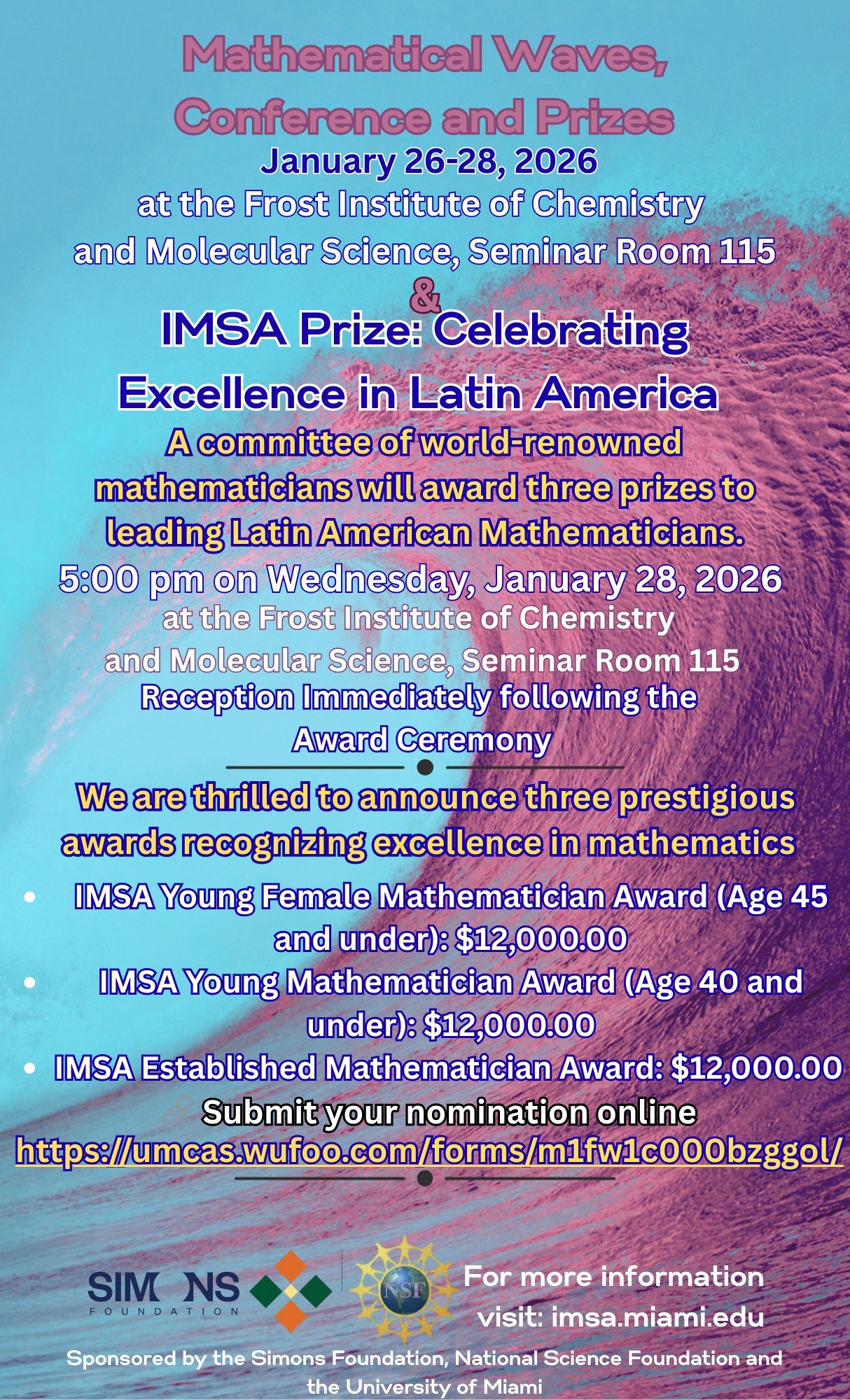
Conference Dates: January 26-28, 2026
Location: Frost Institute for Chemistry and Molecular Science, Seminar Room 115
Live Video Available via Zoom
To register click here
This is the conference of an IMSA series of conferences. The goal of these conferences is to demonstrate recent developments in Mathematics and promote Latin American Mathematicians.
This is an IMSA event, supported by the Simons Foundation, National Science Foundation and the University of Miami.
Schedule
Monday, January 26, 2026
| 9:30am |
Opening
Ernesto Lupercio, CINVESTAV (Mexico); ICMS–IMI BAS (Sofia): Monge–Ampère equations, zeta functions, and renormalization flows for self-organized critical systems
Based on joint work with Nikita Kalinin and Mikhail Shkolnikov, I will describe how scaling limits in self-organized critical models (notably the Abelian sandpile) lead to fully nonlinear Monge–Ampère-type PDE and tropical/affine geometric structures. I will also explain how associated zeta-type generating functions capture universal scaling regimes via distinguished residues, suggesting a renormalization-flow interpretation from microscopic lattice dynamics to macroscopic geometric limits.
|
| 10:30am |
Enrique Becerra, CINVESTAV: Elliptic Genera of Landau–Ginzburg Singularities and the Semiclassical Emergence of the Spectrum
I will explain how to associate a canonical elliptic genus to an isolated hypersurface
singularity, viewed as a Landau–Ginzburg model. In the quasihomogeneous case this invariant coincides with the geometric orbifold elliptic genus of Borisov and Libgober. For general singularities, it is defined using a chiral, vertex operator algebraic refinement of the
twisted de Rham complex. I will show that the semiclassical limit of the elliptic genus recovers the Steenbrink spectral polynomial, revealing the classical spectrum as the topological sector of a chiral modular invariant.
|
| 11:30am |
Jaqueline Mesquita, State University of Campinas: On the Geographic Spread of Chikungunya between Brazil and Florida: A Multi-patch Model with Time-delay
Chikungunya (CHIK) is a viral disease transmitted to humans through the bites of Aedes mosquitoes infected with the chikungunya virus (CHIKV). CHIKV has been imported annually to Florida in the last decade due to Miami’s crucial location as a hub for international travel, particularly from Central and South America including Brazil, where CHIK is endemic. This paper presents a comprehensive mathematical model for the geographic spread of CHIKV, incorporating pivotal factors such as human movement, temperature, rainfall, vertical transmission, and incubation period. Central to the model is the integration of a multi-patch framework, considering human movement between endemic Brazilian states and Florida. We establish crucial correlations between the mosquito reproduction number Rm and the disease reproduction number R0, thereby advancing our understanding of CHIKV transmission dynamics in complex multi-patch environments. Through numerical simulations, validated with real population, temperature and rainfall data, it is possible to understand the disease dynamics under many different scenarios and make future projections, offering crucial insights for devising effective control strategies. This is a joint work with A. Gondim, X. Huo and S. Ruan.
|
| 12:30pm |
Lunch
|
| 2:00pm |
Leonardo Cavenaghi, ICMS-Sofia: Torus actions on the moduli space of stable maps and GKM varieties
In this very introductory talk, we revisit an old topic with a new lens: the one of torus actions on the moduli space of stable maps. We use localization techniques, following Kontsevich and Graber-Pandharipande, to explain how Gromov-Witten invariants can be made combinatorial -- this is inspired by recent work of Holmes-Muratore. Our focus is on GKM varieties: varieties with torus actions having finitely many fixed points and finitely many 1-dimensional orbits. Time permitting, we explain the picture of the complete intersection on GKM varieties, such as the classical Gushel-Mukai 3-fold.
|
| 3:00pm |
Lino Grama, UNICAMP: SYZ for almost abelian Lie groups
In this talk, we discuss SYZ mirror symmetry in the non-Kähler context, in the sense of Lau-Tseng-Yau. We construct SYZ dual pairs for a family of solvmanifolds called almost abelian, and we explore applications related to dualities between Bott-Chern and Tseng-Yau cohomologies. This is joint work in progress with L. Cavenaghi, L. Katzarkov, and P. Muniz.
|
| 4:00pm |
Claudio Munoz, Universidad de Chile: Long time dynamics in Einstein-Belinski-Zakharov soliton spacetimes
In this talk we will discuss recent works with Jessica Trespalacios (U. Austral Chile) where we consider the Einstein field equations in the Belinski-Zakharov symmetry ansatz. We will provide a self-contained introduction to this model describing some recent results on soliton like solutions and their long time behavior in this setting.
|
Tuesday, January 27, 2026
| 9:30am |
Alicia Dickenstein, University of Buenos Aires: Sparse systems with high local multiplicity
Consider a sparse system of n Laurent polynomials in n variables with complex coefficients and support in a finite lattice set A. The maximal number of isolated roots of the system in the complex n-torus is known to be the normalized volume of the convex hull of A (the BKK bound). Together with Frédéric Bihan and Jens Forsgård, we explore the following question: if the cardinality of A equals n+m+1, what is the maximum local intersection multiplicity at one point in the torus in terms of n and m? This study was initiated by Gabrielov in the multivariate case. We give an upper bound based on the computation of covolumes that is always sharp when m=1 and, under a generic technical hypothesis, it is considerably smaller for any dimension n and codimension m. We also present, for any value of n and m, a particular sparse system with high local multiplicity with exponents in the vertices of a cyclic polytope and we explain the rationale of our choice. Our work raises several interesting questions.
|
| 10:30am |
Laura Shaposhnik, University of Illinois, Chicago: A Stroll Through Geometric Ideas
During the first half of the talk, we will introduce Higgs bundles, their integrable system and motivate why they become useful tools to further our understanding in different geometric settings. After describing some dualities they satisfy (not only from mirror symmetry but also via other correspondences such as low-rank isogenies), we will then focus on different methods to understand the Hitchin fibration and branes it contains, and especially its singular fibers (monodromy, transitional geometries, Cayley correspondences). Then, we shall move on to more applied realms and look at how geometric insights can be used to classify viruses, understand the spread of fake news, examine the relationship between COVID and dengue, and address other questions about the world.
|
| 11:30am |
Liliana Forzani, CONICET: Sufficient Dimension Reduction with Auxiliary Information
Sufficient Dimension Reduction (SDR) seeks low-dimensional representations of high-dimensional predictors that preserve all information about the response. This talk presents a two-step SDR framework that exploits auxiliary variables available only during training, while ensuring that the final representation depends solely on the primary predictors. Through examples, I show how auxiliary information can substantially improve performance, either by adding information or by stabilizing the estimation of the sufficient subspace.
|
| 12:30pm |
Lunch
|
| 2:00pm |
Carlos Alfonso Ruiz Guido, Colegio de Bourbaki: Collaborative filtering: learning theory v.s. compressed sensing
In this talk I will present two mathematical explanations of the statistical success of recommendation systems such as the algorithm behind Netflix platform.
|
| 3:00pm |
Marcos Jardim, UNICAMP: Moduli spaces of sheaves on threefolds
While moduli spaces of sheaves on curves and surfaces are relatively well understood, understanding the case of varieties of dimension 3 is considered a hard problem. I will present the main problems and the challenges involved, as well as some of the results we have proved recently.
|
| 4:00pm |
Gabriela Araujo-Pardo, UNAM: A panoramic talk about projective planes, graphs, and colorings
Chromatic theory in graph theory arises from the famous Four-Color Conjecture, formulated by Francis Guthrie in 1852. It states that four colors are sufficient to color the countries of any map, with the condition that adjacent countries must have different colors. It states that four colors are sufficient to color the countries of any map, with the condition that adjacent countries must have different colors.
Thanks to projective planes, the mathematicians interested in discrete mathematics have contributed to solving interesting problems in chromatic graph theory.
In this talk, we will take a tour of several coloring problems that are solved using projective planes, or that address coloring problems on projective planes themselves.
|
Wednesday, January 28, 2026
| 9:30am |
Rodolfo Aguilar, CIMAT: On the log Clemens conjectures: From Classical to Relative Geometry
In the 1980s, Herb Clemens formulated a series of influential conjectures concerning the geometry of rational curves on Calabi-Yau threefolds (such as the quintic threefold in $\mathbb{P}^4$). These conjectures predict a deep relationship between the finiteness of such curves, the structure of their normal bundles, and the behavior of the Abel-Jacobi map. They serve as a bridge connecting algebraic geometry, deformation theory, and mathematical physics (mirror symmetry).
In this talk, I will review the classical "absolute" setting of the Clemens conjectures and the duality between deformations and obstructions that governs them. Then, I will present a new framework extending these ideas to the "log smooth" or relative setting. Specifically, we consider pairs $(X, Y)$ where $X$ is a Fano threefold (like a cubic threefold) and $Y$ is a smooth half-anticanonical divisor (a hyperplane section in the cubic threefold case). I will introduce the notion of "logarithmic Abel-Jacobi maps" and propose relative versions of the Clemens conjectures. We will see how a specific "half-duality" arises in this context, replacing the classical Calabi-Yau deformation/obstruction duality.
|
| 10:30am |
Paul Bressler, Universidad de los Andes: Characteristic classes of natural bundles
I will describe a construction of a complex associated to a Lie algebroid originally due to V. Schechtman and use it to obtain interesting representatives of a characteristic classes of manifolds.
|
| 11:30pm |
Lunch
|
| 1:30pm |
Guillermo Cortiñas, University of Buenos Aires: Directed graphs and their signs
The talk is concerned with a special class of finite directed graphs, the SPI graphs, and the algebras associated to them. A 1984 theorem of Franks says that two SPI graphs have the same sign and the same Bowen-Franks group if and only if they are flow equivalent. A 1995 theorem of R\o rdam says that two SPI graphs with the same Bowen-Franks group have Morita equivalent graph $C^*$-algebras (even if their signs are different). The question of whether the same is true for Leavitt path algebras is open.
In the talk we will define SPI graph, Bowen-Franks group and sign, and will discuss their $C^*$ and Leavitt path algebras, the extent to which such algebras can be classified in terms of those invariants, and how this question is a particular case of a more general classification problem.
|
| 2:30pm |
Luna Lomonaco, IMPA: Algebraic correspondences: Where rational dynamics meets Kleinian groups
The analogies between the iteration of holomorphic maps and the action of Kleinian groups were first systematically explored by Dennis Sullivan in the mid-1980s. In the landmark paper, where he famously proved Fatou's conjecture—that rational maps on the Riemann sphere have no wandering domains—Sullivan introduced what is now known as Sullivan's Dictionary. This conceptual framework draws deep parallels between the definitions, theorems, and conjectures of holomorphic dynamics and those of Kleinian group theory.
Sullivan emphasized striking similarities between the Fatou set $F_f$ and Julia set $J_f$ of a holomorphic map $f$ on the Riemann sphere $\widehat{\mathbb{C}}$, and the ordinary set $\Omega(G)$ and limit set $\Lambda(G)$ of a finitely generated Kleinian group $G$ acting on $\widehat{\mathbb{C}}$. His proof of the no wandering domains theorem was directly inspired by methods used to establish Ahlfors’ Finiteness Theorem in the setting of Kleinian groups, highlighting the profound conceptual bridges between the two fields.
Both rational maps and finitely generated Kleinian groups can be regarded as special cases of holomorphic correspondences. An $n$-to-$m$ holomorphic correspondence on $\widehat{\mathbb{C}}$ is a multivalued map $\mathcal{F}: z \mapsto w$ defined implicitly by a polynomial relation $P(z, w) = 0$.
In 1994, Shaun Bullett and Christopher Penrose introduced the first family of correspondences that contains matings between quadratic rational maps and the modular group, and proved that, for a particular parameter, the correspondence is a mating : it behaves as the modular group on an open subset \Omega, and as a polynomial (and its inverse) in the complement.
Since then, the field of correspondences which are matings between rational maps and Kleinian groups grew considerably.
|
| 3:30pm |
Federico Castillo, Pontifica Universidad Catolica de Chile: Toric Nash blow-ups
Hironaka's celebrated resolution of singularities in char 0 proceeds by blowing up carefully chosen subvarieties. There is an alternative canonical process (requiring no choices) called the Semple-Nash modification, and a fundamental question is whether iterated modifications resolve singularities. We show this is not the case in dimensions greater than 3, and in every characteristic, by constructing counterexamples using toric varieties. This is joint work with Daniel Duarte, Maximiliano Leyton, and Alvaro Liendo.
|
| 4:30pm |
Break
|
| 5:15pm |
Awards Ceremony
|
| 7:15pm |
Live Music & Refreshments
|
Invited Speakers
*TO BE CONFIRMED
| Rodolfo Aguilar |
ICMS, Bulgaria |
Enrique Becerra |
CINVESTAV, Mexico |
| Paul Bressler |
Universidad de los Andes, Colombia |
Leonardo Cavenaghi |
CAMPINAS, Brazil |
| Alicia Dickenstein |
University of Buenos Aires, Argentina |
Jaqueline Godoy Mesquita |
State University of Campinas, Brazil |
| Lino Grama |
CAMPINAS, Brazil |
Ernesto Lupercio |
CINVESTAV |
| Carlos Alfonso Ruiz Guido |
Colegio de Bourbaki, Mexico |
*Bernardo Uribe |
Universidad del Norte, Colombia |
New Miami Mathematical Waves Prizes: Celebrating Excellence in Latin American Mathematics
Submission Deadline: Friday, December 5, 2025
Winners Informed: Friday, December 19, 2025
Mathematicians working in Latin America who are under the age of 45 (for women) or 40 (for men) as of the date of the ceremony.
For the nomination form, please click here.
A committee of world renowned mathematicians will award three prizes to leading Latin American mathematicians. The ceremony will take place:
Wednesday, January 28, 2026 (5:00PM EST Time, US)